BUY MY NEW BOOK:
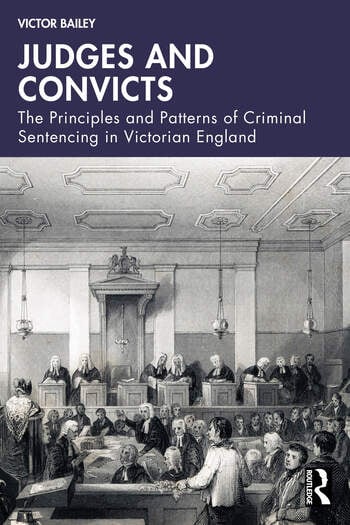
I’m delighted to share that my latest book, Judges and Convicts: The Principles and Patterns of Criminal Sentencing in Victorian England, is now available from Routledge. This project represents years of detective work in the archives, tracking down the sentencing decisions of Victorian judges at the Assizes, Old Bailey, and Middlesex Sessions. What emerged was a remarkable story of transformation—from the harsh “Bloody Code” of the 1830s to an unprecedented softening of sentences by century’s end. I’ve been particularly fascinated by the behind-the-scenes struggle between politicians, civil servants, and judges for control over sentencing, and how a small coterie of professional judges ultimately shaped what I call the modern sentencing tariff. Perhaps most striking is how these Victorian judges, through thousands of individual decisions, created a new equation between crime and punishment that still influences our thinking today. I hope readers will find in these pages not just legal history, but a window into how societies grapple with fundamental questions of justice, mercy, and the purposes of punishment.
I am Victor Bailey, a British social and legal historian. Since 2007, I’ve had the honor of serving as the Charles W. Battey Distinguished Professor of Modern British History at the University of Kansas’ Department of History. For seventeen years (2000-2017), I had the privilege of directing the Joyce & Elizabeth Hall Center for the Humanities.
My contributions to the field are varied, with a particular focus on nineteenth-century British history, criminal law, policing, and punishment. I’ve edited and authored numerous acclaimed volumes, with perhaps one of the most notable being “Nineteenth-Century Crime and Punishment,” a comprehensive work divided into four volumes. These volumes, published by Routledge in 2021, delve into the intricacies of crime and punishment from 1776 to 1914, spanning over 1500 pages of detailed analysis and commentary.

In recognition of my scholarly endeavors, I’ve had the honor of receiving the Walter D. Love Prize of the North American Conference on British Studies in 1998, the W. T. Kemper Fellowship for Teaching Excellence in 1999, and the Marquis Who’s Who’s Lifetime Achievement Award. I am a Fellow of the Royal Historical Society (FRHistS).
My journey in academia began in Yorkshire, where I was born in the town of Keighley in 1948. It was there that I attended Keighley Boys’ Grammar School before pursuing my higher education. I obtained my BA in European History from the University of Warwick in 1969, followed by a Diploma in Criminology from the University of Cambridge’s Institute of Criminology in 1970. My desire to combine the insights of history and criminology led me to the Centre for the Study of Social History (CSSH) at the University of Warwick, where I completed my Ph.D. in history in 1975. Under the guidance of the esteemed E. P. Thompson, founder of CSSH, I focused my doctoral thesis on “The Dangerous Classes in Late Victorian England: Reflections on the Social Foundations of Disturbance and Order.”
Before joining the University of Kansas in 1988, I held various positions at different institutions, accumulating valuable experience and insights along the way. Over my thirty-year tenure at KU, I’ve had the opportunity to engage in both teaching and research, contributing to the academic community in enjoyable ways.
Throughout my career, I’ve also had the privilege of engaging in collaborative endeavors and serving as a visiting research professor at The Open University (1999 to 2002), as well as a visiting research fellow at the Institute of Historical Research at the University of London (1999 to 2000).